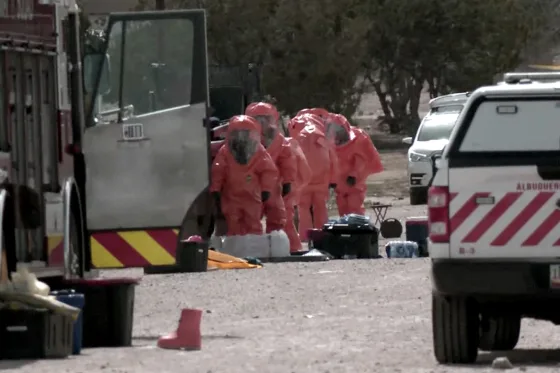
18 first responders were exposed to fentanyl and sickened after arriving at a rural New Mexico home last week to investigate an overdose that left three people dead. First responders found four people unconscious at a home in Mountainair, east of Albuquerque. Two were declared dead at the scene. A third died shortly after arriving at hospital and the fourth survived.
More than a dozen first responders were quarantined after exposure to an unknown substance, with some reporting nausea and dizziness. Lab tests confirmed the presence of fentanyl, methamphetamine and para-fluorofentanyl, also called P4 fentanyl.
| P4 fentanyl refers to para-fluorofentanyl (pFF), a potent synthetic opioid analog of fentanyl. Fluorofentanyl is a fentanyl analogue with the addition of a fluorine atom. |
It is structurally similar to fentanyl but more lipid-soluble, increasing its potency and overdose risk. It is a strong mu-opioid receptor agonist, up to twice as strong as fentanyl. The margin between a dose and a fatal overdose is exceedingly small.
Deoxo-Fluor is a specialized and expensive fluorinating agent. Its presence at the Sandher Lab bust in Falkland indicated a very high level of sophistication.
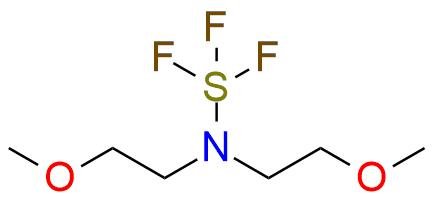 |
Deoxo-Fluor is used to replace oxygen atoms (like those in N-Boc-3-pyrrolidinone) with fluorine atoms. |
Adding fluorine to a drug (‘fluorinated fentanyl’ or ‘fluoromethamphetamine’) often makes the drug more potent. It helps it cross the blood-brain barrier more easily, and can make it harder for standard drug tests to detect. In an industrial lab setting, fluorinating could double production.
Fluorination is a powerful tool in legitimate medicine, but in the hands of clandestine “super lab” chemists, it is used to create drugs that are significantly more lethal and addictive than their non-fluorinated counterparts. The presence of Deoxo-Fluor in Enderby confirms that the Sandher’s chemists were actively modifying molecules to achieve these dangerous effects.

Leave a Reply